Episode 10
Times and Seasons | 010
There are seasons when time seems generous, opening around us with enough room to notice where we are, and others when every hour feels like pressure. In this quiet exploration of our relationship with time, Aaron moves between memory, philosophy, family, and the rhythms of the body to consider how deeply our stories about time shape the way we inhabit a life. From the measured world of chronos to the rarer invitation of kairos moments, the conversation asks what happens when presence becomes more important than the clock. Along the way, experiences of time anxiety, childhood shame, parenthood, work, aging, and life seasons gently surface a larger question: how much of what we believe about being early, late, ready, behind, or successful was inherited rather than discovered for ourselves? This is an episode for settling into the present without pretending calendars and obligations disappear, and for noticing the moments that quietly ask whether we are willing to meet our lives as they are unfolding.
Invitations to Consider:
- When time becomes companion or oppressor. Aaron contrasts two formative memories, holding his infant son and confronting an unfinished seventh-grade assignment, to explore how the same experience of time can deepen presence or become entangled with fear and shame.
- The stories beneath the clock. The episode considers not only seconds, minutes, and hours, but inherited agreements about workweeks, weekends, deadlines, age, achievement, retirement, and when life is supposedly meant to happen.
- Chronos and kairos. Ancient Greek understandings of measured time and the “ripe moment” offer another way of noticing opportunities that cannot always be scheduled or recovered.
- The places we hide behind time. “Not yet,” “I’m not ready,” and “it’s too late” become invitations to examine whether time is genuinely the obstacle or whether it sometimes protects us from fear, uncertainty, or possible disapproval.
- Living according to seasons. Aaron reflects on the contrast between productivity-centered calendars and the natural cycles of rest, growth, strength, harvest, dormancy, aging, and renewal that shape human life.
About Aaron:
Aaron Tabacco, PhD, has spent more than thirty years guiding people through growth and change, often in complex and high-stakes environments. He currently serves as the Director of Staff Experience at a major academic health sciences university. With a background spanning nursing, neuroscience, education, coaching, and mediation, his work centers on helping individuals and organizations navigate identity, connection, and transformation with greater clarity and care.
Known for his grounded presence and compassionate communication, Aaron works with students, clinicians, faculty, executives, and senior leaders across healthcare and other industries. His approach integrates relational depth, reflective practice, and a commitment to creating more humane, integrated ways of working and living. He works in San Francisco, California, and lives in Vancouver, Washington, where he continues a lifelong engagement with writing, music, and the landscapes of the Pacific Northwest alongside his husband and three adult sons.
https://www.linkedin.com/in/aaron-tabacco-phd-83359b9/
https://substack.com/@aarontabacco?r=b5ap9&utm_medium=ios
https://www.youtube.com/@CirclesEdges
Email: aaron@circlesedges.org
Thanks for listening!
Thanks so much for listening to our podcast! If you enjoyed this episode and think that others could benefit from listening, please share it using the social media buttons on this page.
Do you have some feedback or questions about this episode? Leave a comment in the section below!
Subscribe to the podcast
If you would like to get automatic updates of new podcast episodes, you can follow the podcast on Apple Podcasts or your favorite podcast app.
Leave us an Apple Podcasts review
Ratings and reviews from our listeners are extremely valuable to us and greatly appreciated. They help our podcast rank higher on Apple Podcasts, which exposes our show to more awesome listeners like you. If you are enjoying the show, please leave us a review on Apple Podcasts.
This show was brought to you in part by the Magic Thread Media Network. To learn more visit: https://magicthreadmedia.com/
Transcript
Our lives move in patterns, things we repeat, things we return to, rituals, stories, people, and places. The familiar cycles we experience as our signposts, our stations of attention, and then sometimes we awaken more fully to these patterns, reaching a moment that asks something of us-a boundary with an invitation to turn those lines into thresholds of growth and transformation. I am Aaron Tabacco, here again with you tonight. You are listening to Circles, Edges.
Aaron Tabacco:Good wishes and good evening, my friends. I have been looking forward to this time tonight together with you for quite a while. When last we met and sat together to have this circles edges conversation, I shared that I was heading to Vancouver Island, British Columbia, for some much-needed time away. It was a beautiful place. The weather was gorgeous. I had an opportunity to slow down and reflect at least a little bit on things that are important to me. I have to admit, I don't feel that the time away was as restorative and centering as I hoped. Time didn't seem to fully slow down.
Aaron Tabacco:The beauty of the season didn't really penetrate into my body fully. I was experiencing some kind of resistance inside myself, probably tied to external work pressures that really I feel kept me from fully experiencing and receiving the gifts of being present in such a beautiful place, and since right now in circles edges radio we are in this space of examining together these circles of our contextual lives, our environmental circles. It seems like a natural place for me to wander in my mind tonight. To this relationship we all have with times and seasons, I've been doing a great deal of
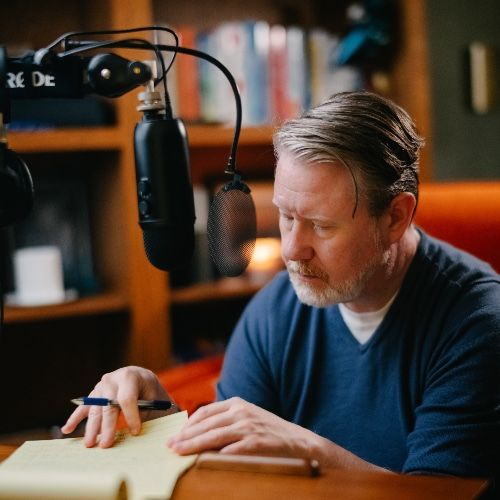
Aaron Tabacco:reflection and writing in preparation to sit down and explore this with you, and maybe discover some new things myself through our conversation. I so deeply appreciate your continued presence with me in this '80s style late night FM talk radio tradition I'm leaning so heavily into with this program. If you are new tonight, welcome. I'm so glad to have you here. I'm meeting you from a very comfortable chair in my home office, a beautiful sort of burnt orange recliner with a rain-scented candle going in the background, while I catch my breath in the middle of a week, and just give myself
Aaron Tabacco:the gift of this pause with you all. I'm not sure how you're arriving tonight. I'm arriving with anticipation and excitement to be with you again, but I'm also arriving with a bit of tiredness and a need to draw myself into deeper presence. So let's begin there. Wherever you are as you're listening, I hope it is not driving an automobile or some other heavy machinery. Given our energy and vibe is so quiet and intimate. I want you to be safe wherever you are, but I hope you will find a space right now. Whether you're walking outdoors in a beautiful natural setting, curling up with your
Aaron Tabacco:earphones on a comfortable sofa, listening in the. Dark from your bed in the middle of the night, or perhaps even hiding in some shelter in the world where things are feeling a little scary. I welcome you here to join me in this safe little bubble and catch a breath with me. Let's just take a moment and breathe. I could use it too. Let all the air out of your lungs. Give yourself the gift of emptiness, and then gently and slowly breathe in deeply, fully expanding your lungs, getting as much air in as you can, holding it there for just a moment, for the count of 4321, and slowly, but
Aaron Tabacco:slowly, exhale that. Purse your lips if you need to, but just slow down your breath until all the air has relieved itself from your body, and then relax. No need to continue with this deep rhythm. Just let your body fall into a relaxed rhythm of breathing. Whatever that is for you is the right pattern. Give yourself a moment. Close your eyes if you need to, or focus on your own candlelight-a flicker outside the window, a reflection on the water-and just fall into a gentle and slow cadence of breathing and relaxing. Tonight we're going to go on a journey together, exploring our
Aaron Tabacco:relationship with time and seasons. Wherever you are listening, and whenever you are listening to this, is the right time for you.
Aaron Tabacco:Having relaxed and taken some good, deep centering breaths, and fallen into that perfect cadence for your concentration, let's jump into tonight's circles and edges. Tonight, I want to begin with some thoughts that are somewhat ancient. The they come from the writings of Saint Augustine. His works, known as the Confessions of Saint Augustine, contain some interesting thoughts about time. He observed in these writings that time is one of those words and concepts we talk about so frequently as humans. It's language that fills our lexicon of conversation over and over, in and out every day,
Aaron Tabacco:and yet it's such a big and complicated thing we take for granted that we even really know what it is. And he famously made the observation that if no one asks him what time is, he knows what it is. But the moment someone asks, "What is time? he can't explain it or define it. I find that is very relatable for me. It might be relatable to you as well. It's one of these forces of the physics of the universe that our entire biology has been shaped by. That we live every day of our lives being acutely aware of, and yet understanding what it is, explaining it to someone, explaining its meaning, the
Aaron Tabacco:way it influences us. What its value is. All of these things are so intimate and personal and subjective. At the same time, we live in a world where we have sort of stories about what time is, social contracts and agreements. And we live by those as well. So there's an interesting duality to these circles of of time we live in. We have agreed, based on our observations of our solar system and our planet, that we can live our lives using a useful story of seconds and minutes, hours and days, months, years, decades-all of those things. Then there are other additional stories we've learned to
Aaron Tabacco:tell, like fiscal quarters, a work week, a weekend, and yet other stories that we link to time with even more nuanced meaning, like when we say, with the passing of a a great in a particular field, that we've come to the end of an era, or that no matter what our choices are, or how we might be stuck with something, time, in fact, marches on. I honestly feel a great deal of sympathy and empathy with Saint Augustine, having done an entire Ph.D. that was grounded in a philosophical paradigm that deeply was influenced by these concepts of time, as understood by Heidegger, and what time means
Aaron Tabacco:for us as beings. And I think the question that I am really wanting to explore tonight, while reflecting on all these various circles of time we experience over and over and over again, is which of these stories about time that we tell ourselves really help us to inhabit life, and which ones seem to imprison us. A couple of different stories from my own life that might exemplify those ideas. First, I want to take you back to a night nearly 30 years ago, when I had my infant son on my chest, lying on the floor of his nursery room, trying desperately to get him to sleep, as he had so many
Aaron Tabacco:struggles falling asleep and staying asleep. We were in that period of time as parents where you become so exhausted that it's all you can do to basically stay awake at any given moment of the day. And there I was with this beautiful baby on my chest, this child who gave me the title I had wanted nearly my whole life-that of father, so so precious to me-and he had finally fallen asleep, and I was feeling oh gosh, such a sense of relief in all that exhaustion, all of the humming and singing and gentle holding that allowed him to finally nod off into a pretty peaceful slumber, and it
Aaron Tabacco:occurred to me in that moment That I wasn't going to be able to have that joy of holding him like this forever, because every single day he was growing more. There would come a time when there were no more lullaby laden evenings on my chest. There would come a time when I wouldn't even be participating in his bedtime routine at all. He'd be completely independent, and I was overcome with grief.
Aaron Tabacco:Actually, at that anticipated loss, I wanted to be able to hold this beautiful son of mine forever in my arms. I wanted to stop time. I wanted to be able to inhabit it fully, and I didn't want that moment ever to leave my consciousness. So I became intensely present in that emotion, I slowed myself down. I breathed in his scent. I kissed his forehead. I surveyed the weight of him on my chest, the length of his body underneath both of my hands. The feel of his little sleeping onesie, the sound of his little breathing, the perfection of his little lips as the air moved in and out, and I
Aaron Tabacco:imprinted that moment on my heart, on my mind, so profoundly that I still can, to this day, inhabit that moment again-that we might think of as lost in time. In that moment, time started as an oppressor and left me as a companion and a co-creator because I shifted from being subject to time to being fully present in it. One moment in my life where my relationship with time truly did help me fully live it and experience it. By contrast, I want to go back to another experience I had many, many years before this, when I was in the seventh grade. My middle school teacher, mr. Vigland, had
Aaron Tabacco:assigned all of our class a large packet of homework, was to be completed over several weeks, and it was part of that transition from sort of, you know, light academics to more robust and autonomous and self-directed learning. He was a wonderful teacher in the classroom, he was a really good man, but it was his job to help prepare us to take on the ownership of our learning. Unfortunately, for the first time in my life that I can remember to this day, the magnitude of this big packet of work was really debilitating, and I didn't actually do it. wasn't done. The day came where we were
Aaron Tabacco:supposed to turn it in. I didn't turn it in. I felt awful. I felt anxious. I don't remember how much time we had been given to do all of this work, but at some point in the days ahead, he came to me and said, "Hey, where's all of your work? And I had to confess that I didn't do it. He was very disappointed, and he was also very surprised. So we had a one-on-one conversation. I believe I was really pretty emotional about it because I think my parents finding out was going to be what I perceived of as the near end of me at seventh grade level, and basically begged him for a stay of
Aaron Tabacco:execution. So he said, "Well, I'm going to tell your parents about the situation, but I'm going to give you an opportunity to make the workup. So he gave me another deadline, a second deadline, the same big amount of work and packet. Of course, that's what I needed to be responsible for to complete and get it done. I felt immediate relief and an absolute commitment to yes, yes, yes, I can get this done. Unfortunately, whatever was stirring in me with the difficulties of this new way of relating to schoolwork wasn't supported, wasn't resolved, wasn't discussed. My father was very angry that
Aaron Tabacco:I hadn't gotten the work done. He impressed upon me that I needed to get the work done, and I was lucky to have extra time. And that was it. There was no interest in what the work was, where my stumbling blocks might be, how he could help me. It was up to me to figure it out, and for a second time, I became so paralyzed by that mountain of work and the ticking time bomb of the deadline approaching that I got nothing done. I was told I was to turn the packet in to the teacher on a particular morning before the start of classes. I had no packet to turn in, so I didn't. Before class,
Aaron Tabacco:he found me and said, "Where's the packet? I actually looked him in the face and lied to him. I said, "Well, I slipped it under your door. He said, "There's no packet under my door. I said, "Well, I don't know what to tell you, but I did the work and I put it under the door for you. I had never cried.
Aaron Tabacco:My own values like that, in that way before, especially with a teacher. I was the kind of kid who loved school, loved learning, did very very well in my classes. He looked very angry. By the time I was in his classroom. I was called to the office, where I was told my father was on the telephone, because of course the teacher had to report what had happened. I don't remember the conversation with my father. I do remember his anger, his very sparse conversation with me, and his grave disappointment, which mirrored the level of disappointment the teacher shared with me as well. I distinctly
Aaron Tabacco:remember him saying, "I've never given a student this kind of opportunity before, and he really let me down. I'm 54 years old now, and I still remember that experience and that story of my own identity in the context of time, deadlines, and pressure is one that has shaped me across all these years. Every time to this day, I have an approaching deadline for something. I experience fear and shame and panic, and I have to really work very, very hard to pull myself together, get focused, get the work done, and deliver it. That story of time became a story of me. Something I've carried with
Aaron Tabacco:me across 40 years of my life, more than 40 years of my life. So you see, this is what I mean about this duality in our relationship with time. Time is one of those circles of life that will present itself to us on multiple levels every day of our existence. Our work day starts at a particular time every day. Our work week starts at a particular day of the week, our work responsibilities are due at a certain point in time. Our family responsibilities are driven by a calendar, might not even be our own calendar, but other family members' calendars or the additive calendar of everyone in the
Aaron Tabacco:home. Yet our relationship with time is one that can either enhance our ability to inhabit our lives, just like that moment where I was holding my oldest son as a baby, or absolutely imprison us in its stories, like the seventh-grade Aaron who completely blew the deadline twice. So let me ask you, because I am so curious. As you hear these stories, as you're reflecting on your relationship with time, what does time mean to you? When in your life do you experience time helping you fully be present for the world and for yourself. When do you feel driven and oppressed and imprisoned by it? And
Aaron Tabacco:what are those pieces telling you? Let's consider some of these circles. Just get a little bit of a survey of what they really are and when they show up for us. On the most basic level, I just think about our biological circles of time. You know these things like circadian rhythms, our own cycles of of rest and wakefulness, of activity, of sleep, of work, of play, that are actually grounded in the energy of our body and its connection with the natural world around us, the light of the day, the dark of the night, the feel of the seasons, the chill in the air, the warmth on the breeze. Our
Aaron Tabacco:body possesses its own unique cycle. Even though there are patterns among all humans in terms of the physiology of time cycles in the body, we have our own, and when we wake up to that, I wonder what we discover about who we are and what we really need, and if we're living in synchronicity with those natural cycles of our body, or if we're not. And I also. Wonder physically about you know how our emotional states, as they're physically impacting our body, are either enhancing or impairing our relationship with time. Just think for a moment about what it's like for you when you are incredibly
Aaron Tabacco:worried and anxious, and feel a sense of heightened threat, a lack of safety in something, does it feel like time is rushing at you? Does it feel like the seconds are only creeping by? Those physiological states driven by our emotional minds plug directly into our perception of what's happening with time and how we will respond to the time we have been given. This kind of reminds me of the psychology of time a little bit as well, and the circle of flow states.
Aaron Tabacco:When it feels like everything is going well, when we feel a high degree of safety, when we feel deeply immersed and engaged in something, we enter right into this idea of a flow state, and we become utterly blind to time. It's as though it doesn't exist, and the only thing that exists is the unveiling present moment, as we're working on whatever it is we're doing, whether that be spending time with a loved one in a relationship, enjoying a beautiful walk in nature, creating an artwork, writing a novel or a poem, welding together a giant building, planting a garden-it's in these moments
Aaron Tabacco:where we feel a certain generosity of time. We might even call it time affluence. We feel rich with it, and it doesn't necessarily even matter that it exists. Time becomes less important as we inhabit ourselves in a state of fully being while we're doing a perfect alignment of what we value and care about, and our actions that we're expressing at that time. Of course, I think there's an opposite of that too, and it's this circle, this very vicious circle of time poverty. I think you must know what I'm talking about. How often in the last week have you even admitted to someone in your life you
Aaron Tabacco:just haven't had enough time to do something? That you don't know where the time has gone. That it seems to have just disappeared. That it doesn't matter that everyone on the planet has had the exact same number of minutes and hours and days. For you, there's a certain poverty of that resource that you experience. I experience. It's a very, very common thing to all of us as people. And then I think too, just kind of building on that, there are the stories of time we tell ourselves collectively that we share. We can certainly argue that time, as seconds, minutes, hours, days, etc. is a very
Aaron Tabacco:concrete, observable, physical thing, and yet this idea of a work week, or a weekend, or a Sabbath, or a month end, or a fiscal year end, or a new year-these are stories about time that we have made some collective agreements about. They might not even be stories that are relevant to us as individuals in our given work or personal lives, and yet we live by them because we received them as the story that this is what time is, and this is what you should be doing with time as it's been defined. We live in a great deal of tension as human beings with those inherited stories of what these
Aaron Tabacco:minutes, days, hours, weeks, months, and years are supposed to mean. But every day we come back to a morning where we get to decide who we are. Every Sunday night, a lot of folks in Western cultures will really resonate with this idea of Sunday scaries, anxieties. That creep up at the end of Sunday with the loss of the weekend, the loss of a certain autonomy and freedom, and the impending doom of the Monday morning workday beginning, a brand new week where there will be so much expected of us. These are the stories that we live in, often without questioning where they came from, how they
Aaron Tabacco:relate to us, or what they really mean in terms of who we are in the world. With that, I want to offer something kind of different, as we're talking so much about physical time as we can observe it, the social constructions of time as stories we tell each other tell ourselves. But stepping into a spiritually intelligent realm for a moment, I want to go back to ancient Greece, which had interestingly enough, two different words for time. There was Chronos, which is the observable time in the universe. Right, the things we were just talking about: minutes, hours, days. However, their
Aaron Tabacco:clocks were organized, sundials to read in the public square, the observed patterns of the universe playing themselves out predictably over and over and over again. That quantitative time was Chronos, and then there was this different concept, Kairos, which was about a specific right or ripe moment that would occur, where something was possible only in that instance, offering us an invitation or an opportunity. I believe it was tied to archery and weaving.
Aaron Tabacco:This idea that when everything is working right, there's a very small moment available for all the working pieces, all the moving pieces, to come together and create the hunter's kill with the arrow, or the beautiful weave on the loom. I really am taken with this idea of recognizing two different facets of time-that which we can count and use instrumentally to get us through all the agreements we've made with the world around us to get our work done and show up on time and be present for our family events and get the kids to football and all of the things, and yet this other concept,
Aaron Tabacco:Kairos, that there are moments of opportunity that present themselves to us, that if we fail to take, we in fact will lose, and very often, because of our immersion in Chronos, we do lose those moments, and we don't recognize it until after the fact. So maybe we can pause our discussion of circles tonight there, and with that jump into the edges of these opportunities, that are experiences of time as they come and go, every moment and every hour of every day of every week and month and year, to see what growth is being offered to us by becoming more acutely aware of time, and not just
Aaron Tabacco:observe time, but our relationship to time, and really deeply ask ourselves if we are not experiencing a great deal more of this chiros idea, these ripe moments that are presenting themselves an opportunity for us to be fully present for ourselves and the universe, so that we can take them. The recurrence of time as guideposts, schedules, measurements of life and the world around us, they give us shape and stability. We've come up with many agreements about time, as we've already discussed. But circles and edges, of course, is always about looking at. The thresholds of our growth in
Aaron Tabacco:recognizing repeated patterns. I personally want to experience more of those chiro moments and seasons. Those moments where I'm fully present and I'm free from what feel like the confines of time and its hold over me, and I want that for you as well, because there's so much richness in those, so much wonderful opportunity to experience life and our humanity when we become fully aware and fully present and fully courageous enough to step across a threshold in a moment that might never return to us with its opportunity and invitation, moments like I described when I was holding my oldest son
Aaron Tabacco:Ethan in my arms earlier tonight in our time together. A moment I realized would pass-that I would never again be able to experience once it was gone, and so I claimed it. I claimed it and made it my own, and it is something as I shared that to this day I cherish and I return to over and over again because of its invitation to joy and fulfillment and happiness. So, if the key to finding those moments is presence, and we're operating under all of these agreements and stories about time, then, what's the practice that gets us to that space? I wish you were here with me right now, sitting
Aaron Tabacco:beside me, in my office tonight, with this lovely candle and this quiet dark night. I am buried in all of my notes, pages and pages of handwritten notes, printed off quotes, bits of research thinking. On one of these pieces of paper, I have written that I I think we have inadvertently come to believe that time is the condition of our presence; that we can only be fully present for someone if and when we have the time. But I really don't believe it is. I think, especially when it comes to recognizing the opportunity and invitation of a kairos moment-that the condition is we let go of whatever
Aaron Tabacco:story we're telling about time in that moment. So let's explore that. Let's explore the edges of these stories that we've already talked a little bit about tonight, and how we might step away from them in terms of our relationship with time. I think the first thing I've come to realize at this point in my life, in this season of my life is that we're not trapped by time; we're only trapped by the stories we tell about it. And I don't want to confuse this Kairos idea with maybe other competing thoughts.
Aaron Tabacco:So let me pause for a second on that, because one of the biggest time story overlords we have is this idea that we're too late to begin. Now it is true that the idea of Kairos is that there's a moment that is ripe and ready that will probably not recur, and very often we don't even recognize it until we're beyond it and it's in our in our hindsight. And it is true that there are probably windows of opportunity that are singular and unique, and will never recur. That if we had taken at a particular point, would have given us far more time going forward to have experienced something differently. I
Aaron Tabacco:mean, a classic example this of this for me is when. Someone says, "Oh, I wished I'd learned to play piano as a child, but it's too late now. I always wanted to be a virtuoso, a concert pianist, and that window is gone. Well, there may have been a chiros moment or season early in life, when our ability to learn and master and grow and perfect the skill of playing the piano would have offered us a lifetime of growth and development that we won't get 1020, 3040, years down the road, but don't mistake that for the story that it's too late to begin, because it truly, until we're in our deathbeds,
Aaron Tabacco:it's probably not too late to begin. We might not become the concert virtuoso at the piano, but that does not mean we can't experience the joy, the growth, the learning, the development, the connectedness, the spirit of it. So maybe that's the first big edge for us to look at tonight: are these stories that we tell about time and who we are, and where we are in our lives, and how those stories either confine us or release us. So let me invite you to just think about your own relationship with time, and ask you where that relationship began. What did your family teach you about what
Aaron Tabacco:it meant to be early, or late, or on time? What did you learn about life events and when you were supposed to do certain things like finish school, go to school, find a partner, be successful, struggle, settle down, retire. What teaching from your family have become sayings that resonate in your brain over and over again, that have become part of your internal time vocabulary. And in spite of all of those stories, what have you learned and come to believe about time that came from your direct experience? And are there circles of time in your life that seem to always, or maybe at least,
Aaron Tabacco:are doing so right now. Draw your attention. What do you think they're inviting you to do or to learn? And at that intersection of your own lived experience and your inherited stories about time and its recurrence, and seasons, and how life should unfold in its rhythms, where are you using time to understand your life, and where are you using it to judge your life? I know I've just asked so many questions, and I want to thank you for your patience and your presence and listening to all of them. But I think it's this first circle of recurring time as a story we inherited, where our first big
Aaron Tabacco:invitation to move beyond it is found. The second example I told earlier this evening about me in seventh grade, and the incomplete work, and the time I wasted, and the way time became a vehicle of shame for me in those years that I've carried with me every ever since, that I have been confronting and challenging, that I have to sit in tension with all the time. I believe this is why this first circle and its edge are so important, because I can sit here talking with you, you know, baring a little bit of my soul about a shame story in relation to time and my own identity, while I am
Aaron Tabacco:literally looking across the room at the wall at a framed certificate of my Ph.D. the The irony of that isn't lost on me. There's no way I could ever have accomplished something like a doctoral degree if I wasn't something different than my shame and my time story and my relationship to it. So please, I just invite you to really closely examine those pieces for.
Aaron Tabacco:You and what invitations to let go of some of those time stories are presenting themselves to you. Now I want to say there's another edge related to this that's a little more nuanced, and it isn't just that our time stories are enslaving us, or confining us, or oppressing us, but rather that there is a little subtle piece of us using our time stories as protection. This is where we use this language of time as a deterrent for taking action that our lives would really benefit from taking. This is where we say, "Oh, not yet. I'm not ready. I haven't earned it. I'm going to put that off
Aaron Tabacco:until things are just a little more right in certain circumstances. So I think the question you might want to consider there is: Where are you using time stories to protect you from some fear, some perceived lack of safety? Where are you waiting for readiness to take an action at a certain place in time that may or may not ever materialize. Sometimes, my friends, we simply use time as a shield because we're afraid. We're afraid of the consequences of failure, the loss of social connections, the distancing of family, or the disapproval of family. I think it's important for us to really lean
Aaron Tabacco:into that, to figure out where we are blaming time for what will become missed opportunities, instead of manifesting the chiros moments as they're presenting themselves, and then taking them. And now I I want to share a question that occurred to me as I was preparing for this evening together with you that has made me stop and really think about this relationship too. And it's this question: Where in time do I believe my best self resides? And if it isn't here and now, where have I located it, and why have I placed it there? I have to admit that as I reflected on this question that I created, I
Aaron Tabacco:realized that I have placed this image of my best self into a future instead of fully manifesting it here in the now. So I'm sitting with an unanswered question within myself, just like this one that I've shared with you, this is one of those things I would love to hear you share your stories with me about. Send me a note, an email to the radio show account. It is Aaron Double A R O n@circlesedges.org. Please share with me your stories of your past kairos moments, the ones you recognized appearing and fully inhabited, the ripe moments you harvested, and the ones you let go or
Aaron Tabacco:failed to recognize, and also this question about locating your best self: where in time have you placed it? Is it now? How did you achieve that? Is it in some future or past? What is that realization helping to raise in your own awareness? And while tonight I feel like I am just filled with questions about time that I could ask infinitely or indefinitely, I think maybe this is the last question in these edges of time and living our lives. I want to get to tonight, and that is, you know, what story about time do you need to release in order to inhabit your life more Fully, what story about time
Aaron Tabacco:do you need to release to inhabit your life more fully? There are so many that occur to me to abandon. Oh my goodness, I think about the fact that nature shows. Seasons that there is a season for planting and growth when the earth is ready to receive plants and seeds. There's a season where all of that pays off, and there's a harvest and a clean up, and there's a dormancy season, a winter, that our our human bodies have evolved deep internal rhythms of this lived experience of time in the context of seasons, and yet when the world began to sort of be dominated by a single story of time,
Aaron Tabacco:as seconds, minutes, hours, days, weeks, and those were driven by industry, work, productivity.
Aaron Tabacco:That we now live our lives according to that story of time on a calendar that is tied to productivity in the workplace, and have completely abandoned the fact that our bodies and the world around us are tuned to seasons-seasons of rest, seasons of conditioning, seasons of strength and performance and output, seasons of celebration, and not only on an annual cycle but across our lifespans. Right now, I inhabit a season in my 50s. It's a season I have come to absolutely love and cherish and celebrate in being here. I hope whatever season you are in in your life is one that you can appreciate,
Aaron Tabacco:respect, honor, love, and cherish, even if it's a difficult season. But more importantly, I want to invite all of us to figure out how to claim the Kairos moments through our presence, through the discarding of the stories, the letting go of the stories, of all these agreements around time, and that is not to say we should all stop living by our day timers and calendars and Outlook tools and Google and all of those devices and things that we use to keep track of the story of time and the agreements we've come to and our obligations, but simply to consider that time is something we need to
Aaron Tabacco:live into, rather than subject to. And if we can do that, we will find that when the time comes for our time to be over, we will look back at all of those chiro moments we claimed with satisfaction and contentment and joy, rather than loss and grief and regret. I want to thank you all for joining me tonight, for keeping me company and diving deeply into time and seasons and our relationship with all of those things. I also want to assure you that you know wherever you are in your journey of seeing and understanding your relationship to time and manifesting a different way to exist with it as
Aaron Tabacco:a co-creator or partner, you're in the right place. We literally wake up every day at the beginning of time. Perhaps that's the great gift. Every moment offers the invitation to begin again or begin anew. But let's transition into circle back. I love this tradition because it's the part of the show that most directly links me to you, and I want to thank you tonight for your patience and even listening to my gravelly voice as we start to wind down the program. Speaking of seasons, right now in the Pacific Northwest, as is true in many parts of the world, we're in a season of unprecedented
Aaron Tabacco:fire and forests and grasslands that are burning. I just want everyone listening tonight. Especially those affected by these awful occurrences across the globe, that I'm with you in all of that. I'm part of our circling back tonight, as circling the globe, connecting in our moments, our uncertainties, our anxieties, and just being together, but the intention of Circle Back is to respond to your outreach, your emails, your messages, and create a few moments of reflection based on something you've shared, usually about a recent episode. I want to share tonight with the permission of this
Aaron Tabacco:particular listener a letter I received recently. He wrote, "Hey Aaron, I listened to the Rings of Fellowship episode and wanted to ask you about the friend you talked about from back in your 20s. I'm 35 and I live in North Carolina. I served six years in the military, and I had a friend from that time who was about as close to a brother as you can get without being family. A few years back, I ended the friendship because of some things he was doing and the kind of trouble that seemed to follow him. I felt like staying close to him could cause problems in my own life. At the time, I thought
Aaron Tabacco:I was doing what I had to do. I still think that's true, but every now and then I wonder about it. And your story brought all of that back up. You didn't say what happened later. Was that really the last time you and your friend had anything to do with each other? Did one of you ever reach back out? Did you ever run into him again or hear how his life turned out.
Aaron Tabacco:I also wondered if you ever questioned your decision as you got older-not whether the danger was real, but whether there was another way you could have handled it. Did you ever wish you had said more before you walked away? Did you leave an open door, or did, or did you know it had to be a clean break? I'm not asking you to tell me what I should do. I'm mainly wondering if that was the end of the story, or if there was more to it later on. Thanks for sharing it, Jason M. Well, Jason, I really wanted to thank you for reaching out. It sounds like this was somebody really important to you, and
Aaron Tabacco:you've spent time reflecting on it, thinking about it, maybe even grieving it, and that feels really relatable to me, so let me return your trust and your kindness by telling you the postscript. While that particular story I shared occurred, goodness, 30 years ago, or nearly 30 years ago, it turns out it wasn't the end. Because about 10 years ago, this incredible friend and brother that I had loved so much-he and I did reconnect, and I was able to share with him that I felt I owed him an apology, not because I made the wrong decision, but because I wasn't capable of the time of showing up in a
Aaron Tabacco:different way, and that I regretted that-that were those things to have occurred now in our friendship, I'd be such a different person than I was then, that I would handle it differently, and probably I would be able to stand beside him as he navigated it, navigated through his difficulties without the fear of being caught up in it as if it were my own. So, in a way, this email that you sent, Jason, also ties to tonight's episodes about time and decisions and chiros moments that sometimes we are. Sometimes we realize we missed in looking back. I think I missed one of those with him simply
Aaron Tabacco:because I wasn't yet prepared to show up in the way that he needed, and while we didn't reignite our connection, we didn't have the same proximity anymore to one another. Our lives had diverged enough that. We weren't going to pick up where we left off. We have stayed in touch, and is loving and kind and respectful. And there still is an element of brotherhood. So maybe what I can share with this part two of the story, especially as it relates to tonight's episode, is that it underscores that sometimes we do miss the moment, but it doesn't mean a beginning or a new beginning isn't available to
Aaron Tabacco:us. I hope that's helpful, Jason. Thanks so much for reaching out. And on this note, I want to share with every one of you some kind of exciting news for me. I'm going to be adding a new dimension to the circle back segment of the show. You all know that as I record these in the evenings, I always have at least one candle lit in my office. It's a really good ritual for me. It helps me center, find my presence. It offers a certain sense of warmth. And recently, I came across a company, a small boutique candle company in New York, that really impressed me with who they were and what they were
Aaron Tabacco:doing, and how they were really authentically showing up in the world, and how they came to candle making as a practice, sort of leaving the stories of time that were negatively impacting them in the corporate world, finding a different path, and this company was very interested in my work. So we're going to do a little partnership together. And while Circles Edges is not a commercial venture for me and never will be, I really wanted to share this company with you.
Aaron Tabacco:And so now and in the future, with each answered letter in the circle back segment, I'm going to send out one of their candles to that particular listener as a gift, as a thank you, as a way to connect me and you, the listeners, maybe more personally, and whether or not we're synchronous or asynchronous in our conversation through this radio show, it just makes me feel good knowing that I'm lighting a candle that might be the same candle you're lighting as you're listening, and one person at a time, we're closing the space a little more fully. So once all of this partnership is sorted
Aaron Tabacco:out, I'm going to tell you more about this company. But I'm really excited about it. Excited that it will offer us a vehicle of connecting more personally and sharing in the experience together more fully. Well, my friends, it has been a long and wonderful and winding journey tonight. We've done a deep dive into the second of three episodes of Circle's Edges, that are examining the circles of our contextual lives, the world around us, time and seasons. So many things on my mind right now that are coming up. I might not sleep quickly tonight because of all of that stimulation. But I will sleep
Aaron Tabacco:better knowing that you've been here with me, that we've been here together. So before I blow out the candle tonight, as is our tradition, I want to offer one last light of inspiration to you, I'm turning again tonight for this to an ancient reference, which seems appropriate since we've been talking about these ancient Greek ideas of chronos, of measured time, and kairos, that ripe moment of opportunity to be fully present and shift into a new way of being, and not missing those opportunities by getting lost in stories about time. This little bit of wisdom is attributed To Heraclitus, an
Aaron Tabacco:ancient Greek, but of course, like many ancient writings, it's survived as fragment that's been included in the writings of many other people who came after. It was written in a gendered form. Which is very common for literature of the time, so I will honor that by preserving the translations and words as best I can. But I want to offer, of course, that this is much larger than man or men. This speaks to all of us as humans. But the writing was this: No man steps in the same river twice, for it's not the same river, and he's not the same man. I think this is a perfect observation to make as
Aaron Tabacco:we all tune out tonight. Wind down. Eventually, close our eyes and head to sleep. If we really think about it, think about this metaphor of life and time as a river. We can think about the number of times we arrive at a familiar bank, maybe in the same season of a hot summer, looking for a little relief, and with our bare feet we jump in, and our sensory system and our understanding of time and seasons generates in us deep feelings of comfort and familiarity, as if we've circled back again to a space we've inhabited before, but it isn't really a space we've inhabited before. The water itself
Aaron Tabacco:is different, constantly moving. The riverbed or stream bed is constantly being reshaped with new deposits, new rocks, disturbances, plant life. Our physical bodies have grown. We've become different people with different experiences than we had the last time we stepped in. So may we all wake up to that, to that awareness that our perceptions of time, our stories of time, are really just illusions, and we get to arrive in familiar places with ritual and celebration, and if we are wise, With freedom-the freedom of becoming and honoring both our past and our future by living our best
Aaron Tabacco:self in that present moment-it's been a loving joy to be with you again, and for now, I will offer you good wishes and a good night.