Episode 6
This Did Not Begin with Me; It Will Not End with You | 006
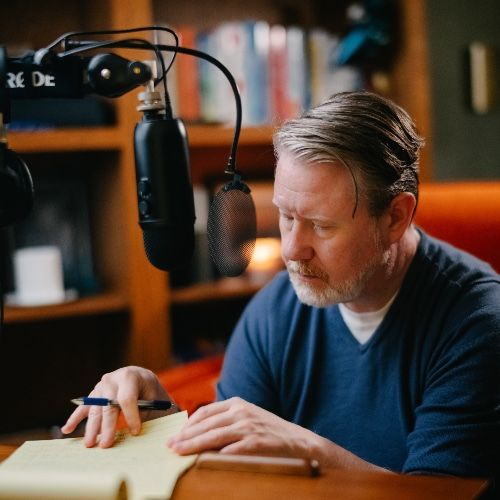
This week Aaron explores the teachers, mentors, parents, guides, and unexpected strangers who leave emotional imprints on the architecture of our lives. Moving through stories of nursing school, fatherhood, rideshare conversations, and the subtle transfer of wisdom across generations, the episode gently asks what it means to truly shape another human being without trying to possess or control them. Along the way, Aaron reflects on discernment, legacy, apprenticeship, and the growing tension between authentic guidance and performative influence in modern life. This conversation unfolds as an invitation to slow down, notice whose voices live inside you, and consider the quiet responsibility we all carry as teachers to one another, whether we realize it or not.
Invitations to Consider:
- How certain voices remain with us for decades, quietly shaping the way we move through the world and understand ourselves.
- The transformative experience of being recognized by another person in a way that awakens something previously unseen within us.
- What apprenticeship truly asks of us beyond knowledge: integrity, discernment, emotional maturity, and the embodiment of wisdom.
- The growing tension between authentic teachers who cultivate freedom and modern forms of influence that seek certainty, dependency, and followership.
- Why openness to outcome may be one of the deepest expressions of love, mentorship, parenting, and human connection.
Light a Candle With Me
A candle is part of my nighttime recording ritual, which makes Keap Candles a natural partner for Circles|Edges. If you’d like to bring the ritual into your own space, explore Keap through my affiliate link HERE
When you purchase through this link, Circles|Edges receives a modest commission at no additional cost to you, helping support the production of the show.
You are also invited to dive deeper with me and join our circle at https://www.circlesedges.org/
About Aaron:
Aaron Tabacco, PhD, has spent more than thirty years guiding people through growth and change, often in complex and high-stakes environments. He currently serves as the Director of Staff Experience at a major academic health sciences university. With a background spanning nursing, neuroscience, education, coaching, and mediation, his work centers on helping individuals and organizations navigate identity, connection, and transformation with greater clarity and care.
Known for his grounded presence and compassionate communication, Aaron works with students, clinicians, faculty, executives, and senior leaders across healthcare and other industries. His approach integrates relational depth, reflective practice, and a commitment to creating more humane, integrated ways of working and living. He works in San Francisco, California, and lives in Vancouver, Washington, where he continues a lifelong engagement with writing, music, and the landscapes of the Pacific Northwest alongside his husband and three adult sons.
https://www.linkedin.com/in/aaron-tabacco-phd-83359b9/
https://substack.com/@aarontabacco?r=b5ap9&utm_medium=ios
https://www.youtube.com/@CirclesEdges
Email: aaron@circlesedges.org
Thanks for listening!
Thanks so much for listening to our podcast! If you enjoyed this episode and think that others could benefit from listening, please share it using the social media buttons on this page.
Do you have some feedback or questions about this episode? Leave a comment in the section below!
Subscribe to the podcast
If you would like to get automatic updates of new podcast episodes, you can follow the podcast on Apple Podcasts or your favorite podcast app.
Leave us an Apple Podcasts review
Ratings and reviews from our listeners are extremely valuable to us and greatly appreciated. They help our podcast rank higher on Apple Podcasts, which exposes our show to more awesome listeners like you. If you are enjoying the show, please leave us a review on Apple Podcasts.
This show was brought to you in part by the Magic Thread Media Network. To learn more visit: https://magicthreadmedia.com/
Transcript
Our lives move in patterns, things we repeat, things we return to, rituals, stories, people, and places, the familiar cycles we experience as our signposts, our stations of attention, and then sometimes we awaken more fully to these patterns, reaching a moment that asks something of us, a boundary with an invitation to turn those lines into thresholds of growth and transformation. I am Aaron Tobacco, here again with you tonight. You're listening to Circles | Edges.
Aaron Tabacco:Good evening, and good wishes. I'm so pleased that you've joined me for another episode of Circles | Edges. It has been a few weeks since we've connected, and as we're arriving together tonight, I think we both could use a good deep breath just to ground ourselves a little bit and settle in. I know that this candle going is certainly helping me find a bit of a relaxing energy. Turning the record button on and saying hello to you, I've missed you, and saying hello to you is a good feeling. It starts to bring forward in me this feeling of connection with you all over the globe, and I really, really look forward to and cherish these moments when my home is finally quiet and the work of the work day is put away and done, and after weeks of thinking about these topics deeply, getting the chance to sit down with you like old friends beside one another on the sofa, diving deep into our hearts and our minds and our souls, slowing ourselves down and just catching a breath together. I hope tonight you're arriving with strong hearts, open hearts, courageous hearts, that we can be fully present for each other together as we dive into episode six of the show. If you've been listening before, you know that we've been exploring these big circles of our lives, these patterns of experiences from the inside out. Our first three episodes were a dive into the interior circles of our lives, and these last three episodes have been focused on the circles of our relational lives of our inner social circles. We just recently talked about friendship or fellowship, and before that, family, but today we're gonna do a deep dive into the circles of teachers that appear in our lives, our relationship to them, our embodiment of them, the ways in which these teachers or mentors help to shape us, how and who we choose to give that important title to, and maybe some questions that can help you really think deeply about the people that you are allowing to shape you in everyday life,
Aaron Tabacco:as the opportunity to learn from someone presents itself over and over and over again across our lifespans, and also I want to talk a little bit about the ways that we ourselves become teachers in the world around us, whether we realize it or not, because all of us embody the way of the teacher, and when we wake up to that, when we wake up to the circle of our own presence in the world as teachers, I believe. Something of a sharp call to action for us to both deeply examine the influences that shape us and the way our influence shapes others. Many years ago, when I was graduating from nursing school, one of the most cherished faculty in our program was retiring, and the students selected her to be our commencement speaker. She had been quite a presence in our program. She taught our pathophysiology courses as the lead educator, areas that she had very deeply mastered over many decades, and she was exactly what you would want in a teacher who really could help you become very good at understanding this foundational work of the human body, but she was also very tough, and to some, perhaps scary testing in her course was very difficult. Paper writing in her course was famously challenging, and when you've built an entire program where you've admitted very high achieving A-level students, you can imagine the anxiety that her courses would provoke for a lot of people, and yet that rigor and that expertise and the brilliance with which she taught us led us to both trust and cherish her and her contribution to us becoming the best possible nurses that we could become, and I don't remember much from my graduation at that time, in terms of, you know, the ceremony and the pomp and the circumstance, the speakers, etc. and I don't remember all of our professor's final speech of her career, but I do remember her saying very distinctly, and I can quote this to this day. When she talked about the work she had been engaged in, and her commitment to passing it on, she
Aaron Tabacco:specifically said, "This did not begin with me, and it will not end with you, and I found that to be so powerful, that on a very busy, exciting mass crowd and family kind of day, those words have stayed with me all these years as a reminder of my position in the stewardship and the lineage of knowledge. This did not begin with me, and it will not end with you. These statements beg us to think about this circle of being shaped and shaping others, who do we allow into the architecture of our lives, and into whose lives have we been invited as architects, and are we receiving and transmitting things that expand our humanity and them and the humanity of others, or are we perhaps inhabiting the shadow side of the way of the teacher? So, as we begin, I'm going to invite you to just hold in your mind perhaps some images and thoughts of those people that you immediately think of when you think of the teachers who have influenced you as we begin this journey into this circle and the edges of growth that teachers invite us to examine within ourselves, and the edges of growth that come from realizing we too are teachers in our own rights. With that, let's take a deep breath together, one of those giant lung filling breaths. Hold that for just a moment. Don't be uncomfortable, and then slowly exhale. Bringing our mind down into our body, into our hearts, grounding ourselves on the floor, the chair, the bed, the sofa, wherever you may be, and when you're ready, we'll begin. There's a common saying that when the student is ready, the teacher will appear, doing a little research into that in the last few weeks has helped me understand that this common saying is not really grounded in a particular text, although it's often misattributed to several different ancient sources from various countries and traditions in Asia, but I still find that it's interesting in that it points to something important, and that is that idea that there is this constant circle in our lives of
Aaron Tabacco:finding ourselves self aware in some way or very curious and engaged and interested in something or experiencing a need to move on in our lives in a way that would be constraining if we didn't, we're seeking to move from one place to another, or we're stuck in a position that doesn't suit us, and when we become ready in some fashion, that the teacher we need may just very well show up. Sometimes that teacher is a circumstance or a situation, but more often than not, that teacher is a person who comes into our life and decides to invest in us as we reciprocate that and decide they're worthy of our investment. Tonight, I really want to dive into this, this phenomenon of opening ourselves to people who shape us and exploring the ways in which this circle manifests itself. As I was thinking about this the last several weeks and writing out the things I know and have experienced in my life, when it comes to teachers, especially since I spent a great deal of my adult life as a teacher in my own various circumstances and forms, including several years formally as a professor, I started to explore the patterns I could put my senses around, and want to share some of that with you to see what resonates when you think about the teachers you've experienced in your life, and I want to begin with this concept of recognition that someone can come into our lives and see us maybe more fully than we see ourselves. They recognize something in us that we perhaps have not seen, or if we have seen, might not have been really valued in the world around us, and it's taken someone else showing up that has a certain capacity or sensitivity to that to point it out, and for some reason being seen by that individual triggered an energy that made us want to go forward in a way we hadn't anticipated, a few episodes back I actually recounted a story of meeting someone in a car, a rideshare app, a young person who was driving me from one location to another, and funny enough, this
Aaron Tabacco:happened not too long ago in another context, I was in a car. Heading toward I forget what it was, I think it was at dinner while I was visiting another city for work, and I got into the car and said hello to the driver, who also was again a young man, probably in his late 20s, possibly early 30s, and I said, as one does, after getting in the car and confirming I was the right person and he was the right driver. I just asked him, so you know, tell me, how your day has been. What's happening in the world today for you? And he responded with so much charisma and enthusiasm, and immediately was able to begin engaging me on a very deep human level, and I will misquote him, I'm sure, because I obviously wasn't taking notes on the ride, but he began with something to the effect of, Have you ever had a day where something just went wrong, but you pulled yourself forward anyway, and he said it with such curiosity and conviction and open heartedness, it wasn't a complaint, he wasn't seeking empathy, he was seeking connection, and he launched into a story that had me captivated. I was 100% enrolled in his story, and very quickly in him as a person. And this 10 or 15 minute ride allowed us the opportunity to dialog back and forth. I talked with him about what I was doing when he asked, and funny enough, earlier that day I had been teaching a leadership course where part of the focus was on powerful storytelling as leaders, and so I recounted that to him. I said, well, you know, interestingly, I've just been doing this work today, and he said, "Oh, that is so fascinating. You must meet some amazing people. Yes, in fact, I do meet some really amazing people, but I have to tell you that what you just demonstrated to me about storytelling was a master class, and I wish that you had been there today for me to call on you, because you so beautifully and spontaneously conveyed that story with so much conviction and power and openness that you embodied exactly what I was trying
Aaron Tabacco:to teach, and I followed that by saying I really want you to know that that is a very important talent and a rare gift, and he turned to look in my eyes briefly while we were at the stoplight and completely lit up, and he said, I don't think I've ever thought of it that way. Said, usually all my friends tell me that I talk differently, that I'm kind of this loving outcast among the people in my world, because of the way I engage and tell my stories and the language I use and the vocabulary I use, and in that world of mine it makes me kind of the odd man out, and I stopped him to say, well, if you've never heard it before, I really want you to know that you have gifts, gifts, and affinities for the way you connect with people so naturally and so deeply, and with so much heart and caring. I hope that you have in your future a career path that will really allow you to center that gift, because it has the potential to really impact people's lives, and it is not a common gift, and I thought that young man was on cloud nine. You would have thought I had awarded him a gigantic lottery check. It's like I'm gonna have to tell my girlfriend all about this. I've never thought about myself this way before. No one's ever said anything like that to me. I. Said, well, I doubt we'll really ever connect again, because of the nature, of course, of ride shares, but please take that with you. Please do something with that, because it is absolutely one of your best gifts, and I've only known you for 15 minutes. My guess is there are probably many more, so of course, in telling you this, I have no idea what the part two of that story is, but I myself have been the recipient in my life several times and key moments of somebody out of the blue recognizing something in me that I didn't recognize myself, and then pointed that out and made me think about it on a deep level, and they taught me something that I didn't know, and absolutely inspired me to move forward, and that has
Aaron Tabacco:been such a profound gift to my life that I have very consciously made an effort to do the same to pay it forward, and in that way, this circle of recognition that is a part of the recurrence of teachers in our lives is just one example of the incredible power that we have to shape each other as humans in even the briefest contexts, of course, there are lots of other things that I have noticed in connection to teachers and the circles they bring into our lives, and most of the time these are not passing conversations, but deeper connections. So, think about the circle, for example, of apprenticeship, this idea that we are not just connected to another person to learn specific knowledge from them, or to gain information, but we're there to also be in close proximity to them, to make a deeper bond and connection with them, to learn not just about facts and figures and skills, but to learn judgment, to learn who we are as a person inhabiting that particular thing that we're learning to be morally developed to learn how to present ourselves to the world with this knowledge we call that professional comportment, but it speaks to this idea that well, once we learn it, at some point as an apprentice, we will likely pass that information on. It seems to be an intrinsic part of the social contract of the circle of teaching, when apprenticeship is the model. Sometimes, of course, the teachers who appear in our world are there because of some kind of knowledge need that's specific to us. Think about this as like the transmission of an intellectual inheritance, so they may be in possession of great facts or knowledge or specific skill, but they also bring us into a world to teach us ways of thinking, ways of knowing they offer us lenses and opportunities and challenges that help us make meaning out of the knowledge that they're sharing with us. These experiences often result in us internalizing the voices of people we have come to really intellectually
Aaron Tabacco:admire. They may say things to us. Gosh, I have had so many, so many different voices from people have come into my world that I've carried over the years. I think about my father as a teacher. I've recounted several times his voice over other episodes, things that I learned from him about friendships, family. By navigating my internal world, I can think about professors I've had, mentors I've had, who have shown up in my life to teach me great lessons, and whether they realized it or not, offered a phrase or an insight that has stuck with me forever. Like, don't ever work for somebody who doesn't share your values or makes you compromise your values. Anytime I think of that phrase, I hear the voice in my head of the individual who said it. I remember my fifth grade teacher once saying to me, only boring people get bored. Erin, to this day, I can hear her. I mean, goodness, that must have been 45 years ago, something of that nature. I wonder, I wonder whose intellectual inheritance you received that brings those voices echoing into your head when you think about the lessons they taught you. I would love for you to share some of those as you consider the circle of teachers in your lives, these people bring so much power and create such impact and impression on us at times, that there's also, I think, a certain circle within this circle of teaching that's about emotional imprinting in some ways, they, they come to bring to us a certain comfort in our interactions. It may be we look at them as a surrogate parent, a wise sage, a rescuer of us at times in our lives when we felt all hope was lost, and because of those emotional experiences we feel particularly connected to them and loyal to them and bonded to them, and often we carry in our hearts a great deal of gratitude, and we generate their words and wisdom out of our mouths to other people when we recognize a need for someone to receive that lesson. It's very similar to, well, not very similar, it's
Aaron Tabacco:exactly similar. It's exactly the point of the graduation speech I mentioned at the very beginning of our time together tonight, that this did not begin with me, and it will not end with you. We are a part of this great circle of teaching, whether we realize it or not, and have you noticed, like I have, that very often the people we truly think of as teachers, the people that have truly shaped us and contributed to who we have become, these people we come to reverence that very often they show up in our lives over and over again at thresholds we're crossing. I think of my own students over the years who may have been in one of my undergraduate courses who years later would see me again for a graduate course or would reach out to me for insight and guidance as they were taking on new career responsibilities and evolving to higher levels of their role in their organizations are going through some sort of identity crisis, spiritual crisis, career crisis years later. When we make these connections in this sort of emotionally impactful way with these people, we're lucky if not only are they worthy of our adoration and gratitude, but extra lucky if they are willing to show up for us over and over and over again in our lives. It speaks to the idea that there is a circle of legacy within this relationship of recurring teachers in our lives, and that that we begin to embody and steward their wisdom and bring it forward into the world, because they have been so incredibly present for. Us, they've been somebody who listened, someone who remained calm. We may have looked at how they handled uncertainty or chaos and made it look easy, or if not easy, made you feel safe in it all, they are often the people that made me feel in my life the most grounded and find spaciousness in spaces where I was feeling so confined or disembodied or uncertain about how to move forward in the world, and why is that. Well, I want to tie in something that I hope you'll find interesting and
Aaron Tabacco:helpful, and I have referenced this work before in the show on Circles Edges Radio, and that is the work of Angeles Arion, who was a preeminent cultural anthropologist who studied indigenous wisdom globally, herself coming from a Basque background and having a deep affinity for cultural knowledge and its preservation, she was so interested in trying to discover if there were universal ways in ancient wisdom that effective humans show up for each other, and she boiled that down over many years into four archetypes, the way of the warrior, the way of the healer, the way of the visionary, and of course the way of the teacher, and the practice I want to focus on and point out tonight is that the way of the teacher is characterized by being open to outcome, not attached to outcome. Let that really sink in for a moment. The people we hold dear as teachers who've most greatly impacted our lives may have had high standards, may have had a curriculum to deliver, or a lesson to transmit. They may have had to hold us accountable for our knowledge through tests, or exams, or repeated behavioral trials, where once again we had to show up and demonstrate whether we really learned the lesson or not, and yet, if you really think about it, what defines the quintessential teacher is their support of our sovereignty. They have no desire to make us a follower, no desire to mold us into them, extending their life to yet another person. A true teacher is willing to sit with us as we negotiate our own emergence, offering wisdom without ownership, and that is such a profound way that we experience the circle of real, true teachers that they support our becoming fundamentally in service to us, and so with that, I invite you to think about once again the people that have been the most impactful in shaping you, the ones you would entitle teacher, whether it was their formal role or not, and just reflect on how they supported your becoming who you were without making you into who
Aaron Tabacco:they were. This is going to be very important when we move into our next discussion around the edges, because I would be remiss if I didn't point out that sometimes our teachers, or those we call our teachers, are people who live in the shadow of that calling or that title. These are the anti teachers, the ones where we look at them and we observe their behavior and the way they interacted with us or others, and we very clearly. Are called to attention and say inside of us, I will never treat another person like that. I will never behave in that way. I will never take that action, because I see its negative impacts, and whether we've recognized it or not, those people have also taught us something, so I guess what I'm pointing out here is that in the circle of this recurring teacher archetype in our lives, and even in the recurrence of being the teacher in the lives of others, we are exposed to some very specific edges of growth, and it's those edges tonight that I want to really focus on, because right now in our current society across the globe, I see a great deal of confusion about teachers and who we are allowing to shape our lives, so let's get into that. so here we arrive again, having explored just a few of the circles within the circles of teachers and teaching in our lives, and we've made our way to the boundaries of those circles, so we can look at what edges they might uncover in us and what invitations they might have to offer. I think one of the first things that becomes apparent is the edge of the end of the teaching and learning relationship, or at least the formal act, or the moment of transition when we're on the edge of becoming our own teacher and moving forward from where we ended the engagement or the learning to march into the territory of the unknown, having learned what was shared with us. These individuals have truly been our teachers, then they would have really helped us with a few deeply important things, one of them
Aaron Tabacco:being discernment, the ability to see the world and our lives and our circumstances a little more clearly, and that comes along with an increased capacity for listening to our own inner voices, something we can think about as reflective consciousness, looking back, being self-aware, thinking about past, present, and future in new ways, and doing it with a voice inside of our head that feels more empowered, more focused in some way, more confident, and able to navigate the steps that are immediately in front of us in new ways, they probably helped us to grow in our own morality and humanity, and expanded us beyond where we were when we met them, and of course, if they have taught us the things we need to know from them in order to move on. Then it would become natural that there's an edge or boundary there of growth, where the next steps we take will be without them, at least in some way. I can't help but wonder, for you, as you've been thinking tonight about those formative, important teachers, what some of those moments were like when you moved from being their student into some other relationship, whether that was becoming a peer or a former student or a future mentee or a colleague, lots of different possibilities there, but there was probably a moment of recognition that you were at that threshold. Of claiming more of your autonomy in the world, and I wonder what you experienced in those moments. For me, I can think a lot of it has been about gratitude, but really taking in with a full and open heart the lessons that I was taught, the very first story on the very first episode of Circles Edges Radio that I shared was the story of one of my teachers from my undergraduate nursing school, Dr. Roe, and I gave a specific example of a lesson she taught, but I also mentioned just how profoundly all of her teaching had been for me, and how it had followed me for many years and follows me to this day in the maintenance of our relationship as
Aaron Tabacco:very, very dear friends, and someone I continue to learn from when she shows up offering wisdom that she can see I might need, or wisdom that I was seeking. She's always been and continues to be somebody absolutely worthy of that investment and attention from me, and I wonder what it's been like for those people with you, and who those people are, and the feelings you have, and how those people have shaped you in ways that may have led you to even feel a certain grief or loss when crossing that threshold from being their student to meaning something else to them in the future of your lives together, very often after we have crossed that threshold, that edge of becoming our own teacher, we move into another edge, and that's the edge of legacy. If we've truly taken the lessons of these teachers into our hearts, we may have taken them into our vocabulary, we may retell their stories as proxies to shape those around us to shape our practice of living or working, or whatever it is we're doing in the world. We become part of this intergenerational transmission at some point there comes the reflective moment where we ask, what am I transmitting? Is this truly me? What am I transmitting, maybe unintentionally, what parts of someone else's story, my teacher's story, have I been inhabiting, and maybe reliving or living out, even though, of course, they didn't ask me to, and what parts of my story, resolved or unresolved, am I using in shaping other people? Are there forms of courage I learned from my teachers that are rippling outward into the world and affecting others? What's my place in this chain of inherited humanity, and am I expanding that? Am I building on this foundation and knowledge, and truly becoming my own person who incorporates that wisdom and adding my own, or am I depleting it, or diminishing it, or belittling it in some way. These questions of legacy don't usually come right after crossing an immediate threshold of moving from student
Aaron Tabacco:into some other relationship with a former teacher. They usually come down the road, but when they come, they really invite us to pay attention to our authenticity, our honesty, our sovereignty, and our agency, and with that, I think we stumble into another edge of teachers and teaching, and that's the edge of authority. Sometimes, in this awakening of legacy, we come to discover that we've unconsciously perpetuated a certain structure. Of learning and ways of knowing that we inherited that shaped them and that are shaping others and that might come only with some deep reflections from other people questioning our teaching, or our influence, our presence, our knowledge. I remember several years into my practice of teaching, I had already become very adept in my classrooms and clinical work. I had very often been the chair of our curriculum committee. At that point, I was mentoring early career faculty with a lot of regularity, and one of my most cherished colleagues - we had shared the same floor at our academic institution - had passed away due to cancer. She had battled for many, many years, and part of her final wishes were that on a certain week when her family was allowed to clean out her office, that they would open the door and they would take and disperse to the family, obviously her personal possessions, but that the family were to invite all of our colleagues in the school to peruse the library she had built over many years and to take any book that it felt right to bring into our lives something that spoke to us, and in my quiet afternoon, looking through all of those books on the shelves in solitude, I stumbled across a title by Bell Hooks of her book, Teaching to Transgress Education as a Practice of Freedom, and while I was familiar with Bell Hooks, I was not familiar with this book, and I found it immediately challenging and provocative, so of course I thought, well, this one is speaking to me. I guess this is the book I should
Aaron Tabacco:take with me, and I did, and I read it, and as I read this book, I really tuned in to all of the ways that I myself became part of an inherited teaching and learning system, and that I perpetuated structures and ways of engaging with students in a very hierarchical manner, even though I myself tend to be very lateral, collegial sort of equity-minded person. I don't really think of myself as a respecter of persons, and I brought that into the classroom. I wanted my students to call me by my first name. I wanted us to be co-creators of knowledge in the classroom, I wanted to learn from them through the process of teaching them as much as I wanted them to learn from me, and yet this book was so provocative in that it pointed out so many ways that even with that self-belief that I had crafted my own practice of teaching in the world. There were so many things I was perpetuating I wasn't even aware of, and it really made me think about how I interacted with my students on a very human level, and one of the observations I made that forever changed my practice was that I realized that in every class I'd ever taught on the first day of class, the way I introduced myself to my students was the way I had only ever seen it done over my entire academic career. The teacher's at the front of the room calls the class to order, says a brief introduction to themselves and the material, perhaps they ask the students their names, or there's some kind of role if they're in that kind of institution, and that's about the end of it, and then they move on, but it occurred to me that in our sort of generalized Western culture, this isn't how we meet and greet and introduce ourselves to people, if we are at a gathering and somebody new come. Into our presence, we don't excuse ourselves, go to a podium, and then take a microphone and introduce ourselves to them, and then not ask anything about them. No, no. What we do, by and large, is we look them in the eye, we shake
Aaron Tabacco:their hand, or at least offer to shake their hand, and we introduce ourselves, and we ask about them, and so that's how I, well, at least one of the ways I began changing my practice of teaching was that when my first day of class with any new course began, and the students had assembled, I'd actually leave the front of the room, and I would go to the back of the room, and I would start at the farthest desk, and I would introduce myself. I'd offer to shake hands if they were willing to do that. I'd ask their name, and I'd thank them for being there, and I would tell them it was genuinely a good thing to be meeting them, that I was really happy to meet them. There wasn't a time where I would get back to the front of the class to begin that I even had to ask for people's attention. When I stood and faced the students, they were connected and interested and engaged and had enrolled in our relationship in a new way, so this edge of authority that we stumble into when we're examining our relationships with our teachers and the people that shape us, and we take on autonomy and sovereignty and authority in transmitting that back out into the world, whether it's in a formal classroom, in our relationships with our children or peers, people in the general public, people in our rideshare, it doesn't really matter when we become aware of this edge, it invites us to think very carefully about how we're stewarding the transmission of this knowledge and wisdom, and these lessons of being to other people in the world around us, one might even be able to say that the exploring the edge of authority takes us to the edge of differentiation, really inviting us to decide if we're just performing someone else's story in the world, or if we've learned from it, incorporated it into who we are, been shaped by it, and yet transmitted it in a way that is true to ourselves. And this tonight is where I want to transition a little bit from the at least some of the edges of our growth that
Aaron Tabacco:are available when we think about the teaching learning relationship in life that we experience over and over again to a place that I have found myself being very concerned with, increasingly so over the last few years, and I wonder if you have maybe shared some of these concerns as well, and that edge is, how do we as human beings learn to discern who deserves formative influence over the architecture of us, can we parse out the difference between influence and wisdom from charisma and integrity, or confidence from competence, performance from embodiment. I think we need to really ask ourselves those questions, because if we don't, we are very vulnerable, especially during periods where our identity feels like it's in flux, where we're stuck or frustrated with the world, where we're trying to maybe learn something new and push beyond a former boundary we've experienced of ourselves in some way is in those higher emotional states of seeking. If we can't truly discern who deserves influence in our lives, we set ourselves up to be shaped by folks. Who may not, in fact, deserve that influence because they use that influence to further themselves and not us, and why would any of us want to invest our attention and admiration and our willingness to be shaped by another person. Why would we invest that in somebody who used the relationship to simply further their own needs? Because inherently they don't have our best interest or needs at heart, and I see so much of this in the world right now, and the rise of it has been captured in this idea that stemmed from the birth and growth of social media of quote influencers and if we've been going through a period, for example, of loneliness or uncertain identity, if we find ourselves in a place of questioning systems and institutions and traditions, and we're not finding satisfactory answers, and we're not capable of accessing our own inner wisdom and a sense of discernment in those moments. Then we open ourselves
Aaron Tabacco:up to people who seem to speak to those uncertainties with certainty, they speak confidently. They may simplify complexity, making things easier for our brains to digest, and not necessarily in an artful way, but in a reductionist way that might be taking out some of the nuance, might be removing some of the important challenges we need to work through to understand something in the world. They tend to name frustration and draw you into it, provide a sense of sort of false belonging. They perform authority, and they perform authenticity, but it's a performance. It's not embodiment, it's entertainment, it's influence. They're not looking for you to learn from them, they're looking for you to follow them. We have all been susceptible to this, but it's becoming a very globally prevalent phenomenon of great concern because we are failing sometimes to ask the questions that really matter, like what qualities make someone worthy of influence in my life. What happens to me the longer I listen and engage with them? Are they able to deepen my humanity, or are they just stimulating me? Do they invite me to increase discernment, increase the ability for my own independence, invite me to disagree, invite me to grow, invite me to expand, or rather, are they just looking for a certain dependency through this false sense of intimacy through the repeated exposures? Do they cultivate in us reflection or outrage? Do they invite complexity? Because the world is a very complex place filled with uncertainty and gray areas, and the need for every single one of us to journey from one point of who we are and what we inherited from our parents and friends and other influencers and influences, excuse me, in our lives, or are they potentially just monetizing certainty, because for some reason that certainty calms our nervous system, do they help us? Do they help me become more ethical, more human, more relational, more compassionate, and grounded, or do they take me down a different path?
Aaron Tabacco:I think on a personal note, this is very important to me because. I, as you've heard in the past, and, and have been for many, many years raising three sons in the world, they're beautiful, they're courageous, they are intelligent, and worldly, and engaged, they're curious, they're talented, of course. I'm very biased in all of those things, but as a parent, I've always wondered about my influence in their lives and what the proper role of that influence is. I have recognized when I've overstepped that influence and had to pull back, so as not to try and convey a sense of ownership, but rather of safety and stewardship. Those are very different things, and I am so mindful about it, because I love them. I brought them into this world they are a part of me in a very real, very physical, very emotional, and very spiritual way, but I recognize even though they're young adults, 3026, 23 that so many voices in the world that are coming at them do not have that care and investment, and I wonder what you're seeing out there. I wonder if you find that you're in a space right now where there's something slightly unsatisfying about the voices that are coming at you in in the world, and if you might be in a place of openness to using some of these ideas to determine if those voices are worthy of having influence in shaping who you are, truly worthy, truly caring about you and your progress in the world, truly embodying the idea of openness to outcome, not attachment to outcome, because remember that's the essence of a true teacher, they are fully open to this being your journey and committed to helping you own your journey and manifest your life under your own authority, and not molding or shaping or controlling you by turning you into simply one of them. It's a pretty deep edge tonight, but you know, I am grateful that I've had teachers in my life, who were worthy of shaping me, and I know they were worthy of shaping me, because I became more of myself, more
Aaron Tabacco:authentic, more powerful, more courageous, more intelligent, more skilled, because of their willingness to be open to the outcomes of my learning and my journey, and I suppose to some degree there have been some indicators of success, that that's the legacy I myself am passing on. I remember several years ago my youngest son at the time, who I think was 19 years old, sent me a text out of the blue one morning. I had been living and working in another city for a few years. I was working in San Francisco, but my sons were in the Pacific Northwest, and I absolutely did not like that distance. It was necessary for my career and for our family, but at the same time it was a terrible position for me to be in, because I only ever wanted to be a father and I only ever wanted to be buried in my boys and surrounded by them every day, and so that distance was really challenging, but it did offer us some learning that we could engage in together, and it did help us to not take advantage of one another in our relationship. And one morning, out of the blue, 10am my youngest texted me and said, "Hey, good morning, Dad. Just wanted to tell you I love you very much, and I miss you tons. This was not typical communication for him, but I found it so moving. Of course, I responded and told him that I was so excited that I would be moving home soon, finally, because I missed. Him, we exchanged a few more words, and for some reason he said, I just want you to know that you're teaching me without teaching me, and I have learned tons from you, and I think about all of the edges that my learning journey with teachers in my life had exposed me to, all I could think of in that moment was how grateful I was that they taught me to be open to outcome instead of attached to it, and that I had been able to practice that, as difficult as it is as a parent, with my sons for their benefit. My hope tonight, and all of this wandering we've been doing around the teachers in our lives, in the way we
Aaron Tabacco:show up transmitting their wisdom and our own wisdom to those around us, when we inhabit the teaching role that we can simply embrace very deeply the practice of being open to outcome, not attached to outcome. It enlarges all of our humanity, it preserves our freedom, it enhances our autonomy and our sovereignty, and ultimately it leads to a world of creativity, generosity, and a profound sense of connection tonight tonight, in the spirit of this, did not begin with me, and it will not end with you. We'll move into our tradition of circling back to previous content and episodes and moments we've shared together, I've heard from several of you in these last few weeks, and I want to thank each of you who's reached out for your love and your kindness, your affirmations of seeing me in the work that I'm trying to do, and your joining me in it tonight. I have a few special thoughts I want to put out there into the ether for all of us to sit with, so join me, kind of sidle up beside me for a moment while I send out expressions of gratitude to a dear friend and listener who reached out this week, especially after having recently gone through a very significant loss of a 40 year beloved friendship with a passing of a very dear person in her life, it's not my story to tell, so I won't share all of the details of this email I received from this listener and very dear friend in my life now, but dear listener, dear one, I am so grateful that listening to the last episode on fellowship and friendship resonated with the way you and your friend tended to one another, and I am holding you from afar in these moments of grief and loss, and sending you strength and the joy of many shared memories with someone it sounds like who has been both a peer and friend and colleague, and perhaps even at times a teacher in your own life, I'm thinking of you, and as I say often to my partner, when we are apart, warm arms around you. I also want to send a few thoughts out tonight to
Aaron Tabacco:listeners around the world that I've seen consistently showing up for Circles Edges Radio in places where I'm just so honored to know someone's listening, so thank you. You to those of you listening in Helsinki and Manchester, Dublin, and Cork, my listener who's been tuning in from McConnell Air Force Base. Of course, I have no idea who you are, but I want you to know I'm thinking about you. I'm thankful for your service, your focus on living a life of discipline. I hope that you are as much a heart warrior as I must think you are, given your tuning into this particular show. Two friends listening in that I've never met from places like Clovis, New Mexico, and Toronto, several cities in India. Oh my goodness, I'm so excited, and wish we could connect more personally to listeners in St. Albans in England, a city I know and I've lived in, we share an affinity. I would love to connect with you more. Those of you in Paris and Bangkok, I think of you as well as I equally think of my listeners who've been calling in, or sorry, listening in, rather from Montclair, New Jersey, and Smithers, British Columbia, and Baldwin, Missouri, an entire branch of my family is from Hannibal, Missouri, actually, a couple of generations back, so I'm sending out warm thoughts to you, to all of you tonight, to thank you for joining us in this circle on this show, and keeping me company as I muse through so many different thoughts every time we get together for these nightly conversations, and I want to remind you that I am truly here on a very personal level for each of you as well. If you'd like to reach out and have a more personal conversation, whether it's anonymously or directly, I'm open to all of that. I won't share anything that would identify you on the show, unless you would like me to, but we can talk about that if such situation and circumstances arose. But in order to do that, you need to know how to reach me, and you can do that through email at Aaron at Circles
Aaron Tabacco:edges.org that is double A R O N at Circles Edges one word.org I really look forward to hearing from you, we're hitting a milestone tonight, you and I together, as it's time to end this episode of Circle's Edges, I notice that the candle is down to the very bottom. Two of its three wicks have extinguished, and there is one last little light in there, and this candle has been with me since the beginning of the show, and now that we have crossed the threshold of the halfway mark of this planned first season, I just want to explore this last light tonight. In that context, I am so grateful for what we are building together and finding one another and keeping one another company and caring about each other and listening to one another and being fully present and being open to outcome and not attached to outcome with this show as I only feel in all honesty, like I'm kind of a steward of it, feels like something coming to me and through me rather than of me in so many ways. So I think together we are co-creating the experience of circles edges, and I'm grateful for your presence in all of that. With the end of this session tonight, we're closing out on the first two of the rings that we're exploring in the show. The first three episodes were a deep dive into a few of the circles of our interior lives, and with these last three episodes, we moved outward a little bit to circles of our relational lives, the people we keep in our inner circle our closest people. We're next going to move into the circles of our lived spaces, the circles we experience in the environment and world around us, the places we return to, the dates. that become rituals and traditions, the seasons of the world around us, and how those influence and invite us to think about our growth, the edges apparent within all of those, so I'm looking forward to that next week. So, for our last light tonight, I just want to re-emphasize that true teachers approach us with openness to outcome and
Aaron Tabacco:not attachment to outcome. They increase our capacity for reflection rather than obedience. They cultivate freedom rather than asking followership of us, and I recognize that that can really require courage, the ability to apply curiosity in the face of resistance. That's my definition of courage. So we'll leave you with this wisdom tonight from one of my favorite teachers, Auntie Pema, a name I evoke often on the show, Pema Chodron, the American Buddhist nun, who wrote that the only reason we don't open our hearts and minds to other people is that they trigger confusion in us that we don't feel brave enough or sane enough to deal with to the degree that we look clearly and compassionately at ourselves, we feel confident and fearless about looking into someone else's eyes. If we learn to open our hearts, anyone, including the people that drive us crazy can be our teacher. Thank you for being, and thank you for being here, dear ones. With that, I'm blowing out this candle and going to bed, and I offer you my good wishes and a good night.