Episode 3
“Fix”-ation | 003
Email: aaron@circlesedges.org
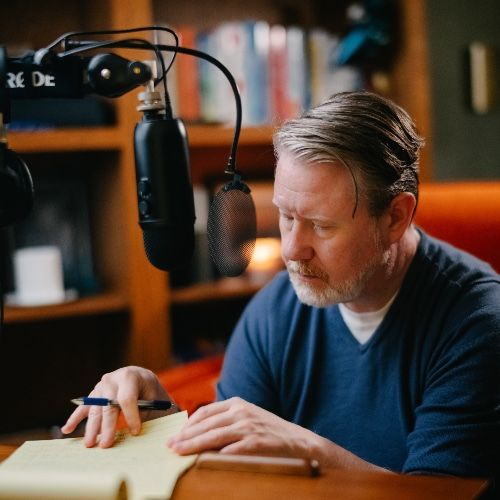
There are moments when the world feels heavy with brokenness, when problems gather around us and something inside wants to move quickly toward repair. Aaron gently lingers in that space, exploring the quiet pull to become the fixer in every room. With steady presence and thoughtful questioning, he invites us to notice the subtle line between compassionate presence and identity built on being needed. What happens when helping becomes who we are? What tightens inside us when conflict appears, and what softens when we choose to sit with discomfort instead of controlling it? Through reflections on burnout, empathic distress, and relational tension, Aaron opens a path toward deeper self-awareness and spiritual growth. Rather than rejecting service, he encourages a more spacious way of showing up, one rooted in wholeness instead of fear. The conversation settles into a simple but profound question: who are you if you are not fixing?
Invitations to Consider:
- The difference between fixing as control and presence as companionship in service.
- How empathic distress can drive reactive helping behaviors.
- The emotional cost of attaching identity and self-worth to being needed.
- Why sitting with discomfort can deepen relationships and reveal truth.
- The societal consequences of collective “fixing” rooted in fear rather than awareness.
Light a Candle With Me
A candle is part of my nighttime recording ritual, which makes Keap Candles a natural partner for Circles|Edges. If you’d like to bring the ritual into your own space, explore Keap through my affiliate link HERE
When you purchase through this link, Circles|Edges receives a modest commission at no additional cost to you, helping support the production of the show.
You are also invited to dive deeper with me and join our circle at https://www.circlesedges.org/
About Aaron:
Aaron Tabacco, PhD, has spent more than thirty years guiding people through growth and change, often in complex and high-stakes environments. He currently serves as the Director of Staff Experience at a major academic health sciences university. With a background spanning nursing, neuroscience, education, coaching, and mediation, his work centers on helping individuals and organizations navigate identity, connection, and transformation with greater clarity and care.
Known for his grounded presence and compassionate communication, Aaron works with students, clinicians, faculty, executives, and senior leaders across healthcare and other industries. His approach integrates relational depth, reflective practice, and a commitment to creating more humane, integrated ways of working and living. He works in San Francisco, California, and lives in Vancouver, Washington, where he continues a lifelong engagement with writing, music, and the landscapes of the Pacific Northwest alongside his husband and three adult sons.
https://www.linkedin.com/in/aaron-tabacco-phd-83359b9/
https://substack.com/@aarontabacco?r=b5ap9&utm_medium=ios
https://www.youtube.com/@CirclesEdges
Email: aaron@circlesedges.org
Thanks for listening!
Thanks so much for listening to our podcast! If you enjoyed this episode and think that others could benefit from listening, please share it using the social media buttons on this page.
Do you have some feedback or questions about this episode? Leave a comment in the section below!
Subscribe to the podcast
If you would like to get automatic updates of new podcast episodes, you can follow the podcast on Apple Podcasts or your favorite podcast app.
Leave us an Apple Podcasts review
Ratings and reviews from our listeners are extremely valuable to us and greatly appreciated. They help our podcast rank higher on Apple Podcasts, which exposes our show to more awesome listeners like you. If you are enjoying the show, please leave us a review on Apple Podcasts.
This show was brought to you in part by the Magic Thread Media Network. To learn more visit: https://magicthreadmedia.com/
Transcript
Our lives move in patterns, things. We repeat things. We return to rituals, stories, people and places, the familiar cycles we experience as our sign posts are stations of attention, and then sometimes we awaken more fully to these patterns, reaching a moment that asks something of us, a boundary with an invitation to turn those lines into thresholds of growth and transformation. I am Aaron tabaco here again with you tonight. You're listening to circles edges.
Aaron Tabacco:Good evening and good wishes to you. Thank you once again for joining me tonight, for showing up and arriving here at circles edges. I've been looking forward to this for many days, the chance for us to get together, sit down together, have a nice, deep conversation. So I have my candle going. Seems to be raining outside my home office window tonight, so there's some gentle sounds in the background. For me, the trains continue to come and go. Seems a busy night for them, they hope they don't bother us. But I am so pleased we get a chance to meet together again. And I'm really thankful you're here. I'm so grateful for the trust and for your companionship, and I wonder how you're arriving tonight. What's going on in your heart, in your mind, in your body? Oh, my. It has been quite a time recently, hasn't it? So many things going on in the world around us, so many things it feels like need fixing, so many things that seem broken, and that brokenness feels like it's weighing down pretty heavily on me, and I wonder if it is for you as well. And tonight, as we arrive together, I just want to invite us to take a really deep breath, find some spaciousness inside of us. You and me both not sure where you're joining from tonight, hopefully, like me, you're relaxing in a favorite chair or maybe laying down in bed or propped up on the sofa. Maybe you were listening in in the daytime, out for a walk, or like me when I was a child, laying in bed, listening late at night, trying to find someone comforting, to listen to, someone to feel not quite as alone in the world with I suppose you could be arriving in many circumstances. In all honesty, it's probably not worth trying to anticipate all of them. But however you're arriving, welcome. Thank you for being here. Thank you for bringing your full self here, joining me as we sort of tackle another episode of circles edges radio tonight. I think I'm just going to keep calling it circles edges radio. That's what I want it
Aaron Tabacco:to be, whether this is or not, whether the platform is currently this podcast modality makes no difference. I'm breaking the rules of time, taking me back, taking us back to a different space in a different era, connecting us late at night or maybe in your daytime anyway, with all of that, thank you for arriving, I already seemed to mention that it's been really obvious to me that there are a lot of things that need fixing in the world around us. So tonight. My mind has been caught up. Actually, it's been caught up for a few weeks now on this topic, these circles of brokenness that present themselves to us, these cycles of things that show up, that create in us some kind of awareness that something feels off, seems wrong, something's hurting, something's uncomfortable, whether that's internal to us or something we're witnessing in the world around us. And I'm very taken right now with our relationship to that situation, because it seems to me that there's a lot of reactivity in the world right now, a lot of agreement that there's a lot of brokenness and a lot of problems, and a whole lot of disagreement about how to approach that, or if we should approach it at all. So that's where I'd like for us to go tonight, as we explore this internal circle from the center of all the circles we live in in the universe, just like we have done in the past few weeks, looking at masks, looking at our relationship to uncertainty. Tonight, I want to talk about this circle that invites us to discover a little bit more about who we are when confronted with these things in the world that seem broken. So with that, I invite you to sink a little deeper into your chair or your bed. Breathe a little deeper on your walk, relax your hands and your legs a little bit more if you are engaged in some activity, and let's see what we can find as We jump into tonight's circle of problems and our relationship with fixing
Aaron Tabacco:a while back, a really dear friend of mine reached out and he'd been going through a very difficult time, spending several days unable to get out of bed, unable to interact with work, the world, family, spouse, very similar in age to me and someone I've known for many, many decades. So there's a lot of deep history. And this was truly something concerning, because it was so far out of experience for him and for me, knowing him, and as I listened, I came to realize that my very dear friend had reached sort of a breaking point, a space of deep, spiritual, emotional, cognitive and physical burnout. And of course, as somebody who was very highly self aware and concerned about the world around him and his responsibilities, he was very strikingly concerned for himself too, trying to understand what was going on and why things were happening this way, where all of His energy had been depleted as we talked in conversation over many weeks, he came to realize that he had lost himself and that this loss of self had stemmed from a really deep attachment to behaviors of fixing the world around him, he had always taken a great deal of personal pride and found a lot of value in being someone who others could immediately reach out to for help, and somewhere, in some way, in some time, he would, in fact, be able to come up with the answer, the fix, the way forward, the strategy, so much so that it really became. Him his identity. He identified himself in the world as a fixer, and after five decades of doing that, came to a place of no longer recognizing who he was or what he wanted or needed in the world, and that he had been slowly starving himself, failing to have his own needs met, and in many ways, having to go on a deep journey to figure out what those needs even were. Does any of that sound familiar to you? I know for me, it was something very relatable. I had spent a lot of my early years, especially feeling very attached to this identity of being
Aaron Tabacco:somebody who could really make a difference crafting my career and my growth and my personal journey, my professional journey, to be someone who would be sought after and trusted and needed for help. So when this constant cycle of problem or difficulty or conflict would arise in the world around me, I felt most at home and most comfortable because I knew immediately that I would be needed and valued and appreciated. So of course, I would deliver on that every time, over and over again. So this is where I'd like for us to spend a little more time tonight. What happens when in our interior life, our altruistic and compassionate desire to genuinely be of service in the world finds its way into our very identity and leads us to a situation where that very desire becomes intermingled with a lot of other internal pieces of our identity and our needs, essentially what happens when presented with this circle of problem after problem after problem, and we give and we give and we Give only to find ourselves empty and depleted and lost and uncertain of our own identities. What edge is that exposing in us? What's the boundary of growth here? Because, I mean, isn't it a good thing to want to be helpful in the world, isn't it a morally elevated position to recognize conflict and suffering and difficulty and want to put ourselves in the ring as somebody who answers the call, given that I spend a lot of time reflecting on these episodes and this content, scrolling out notes, making little diagrams, examining my thinking for all of that, none of this is scripted, and so I have to ask your forgiveness if at times I feel a little BIT RAMBLY, but like late night radio, this is the conversation I find myself having these thoughts and wondering about them. Sometimes they're complete, sometimes they're incomplete, but just like I would be sitting with any of my other closest friends and going deep into the conversation with you, that's what I'm wondering about. There are so many
Aaron Tabacco:severe, deep and very consequential problems presenting themselves in the world around us. They need us to show up. The world needs us. I need you. I've said that many times, showing up in your sphere, helping being a light, offering your presents, offering your gifts. And yet, here I am tonight, saying, But hold on, let's examine the shadow of that work and that desire. Because I really do think if we are going to be positive forces pushing back against this. Darkness in the world truly helping to fix the problems that matter to improve life for all of us, I think we have to really deeply examine how we show up in those situations, and if we are showing up truly in service to the world, or if we're showing up in service to ourselves, and that's the edge, the edge and the shadow of this work of this circle that repeats itself over and over and over in our lives, is to figure out how to parse out all the goodness of helping and fixing and engineering and being a force of good from the dark side of that which is using those situations as a vehicle to meet our own needs, and if you would like to more fully see that edge, I would just offer you one question, Who are you if you're not fixing, who are you if you aren't helping? Do you have a sense of your own whole complete identity, or if those pieces were taken from you? Would you feel like my friend expressed, feeling lost, empty, uncertain and maybe even a little bit hopeless, that's where the growth for us can be discovered. I personally believe. I want to show up for the world as a helper, as a safe place to land, as a witness of suffering, as a companion of growth, I want to push back against all this darkness, right along with you. And personal experience has taught me that the only way I can do that in my life has been by dealing with looking at the shadow of what my unmet needs were and how those related to my desire to be present in the world in a positive way.
Aaron Tabacco:Let's see what we can find in here that might be useful to you as well.
Aaron Tabacco:So here we stand at the edge of a new area of awareness about ourselves. We've been examining this cycle, this circle that some of us may relate to being drawn into over and over and over again, that of wanting to jump to fix the people and the situations around us with some kind of attachment to it. That attachment may be even as deep as our own self esteem and our identity in the world. And of course, it seems again that this awareness of this pattern is also an invitation to look more deeply at ourselves. There are a lot of ways that this fixation we have with solving everyone's problems or remedying the situations around us manifest themselves. Let's see if any of these are familiar to you. I have drawn on these from my own experiences, from my experiences working with other people, professionally and personally, and maybe some will seem recognizable to you as well. First off, I think, is this manifestation that links to what we talked about when we got together last time, about uncertainty and how our body and minds and hearts react to uncertainty around us, chronic attachment to fixing might be signaling that our body is looking for a way to regulate the uncertainty we're experiencing in a person in front of us or a situation. And we jump right away, because we can't distinguish between danger and maybe discomfort, and so our reflex is to act, to take steps, to fix things right now, anything that we can do to eliminate that sense of danger within us, even if it's not really danger. So I think part of the invitation here, if that's something you relate to, is this learning to distinguish danger from discomfort to learn that we can create some spaciousness there, to regulate ourselves without having to jump in and regulate the other person or the situation, but to step back, dive deeper into our bodies and give us a pause so we can take in more information. Give things a moment to evolve before we respond. It could be that there is a lot more information
Aaron Tabacco:there for us to gain access to if we can just invite ourselves to recognize what we're feeling and this problem showing up in the person in front of us is not our pain and Not our journey, even if we desire to accompany them. And I think that might be one of the cruxes of all of this, is that we have an experience of fixing as a way to exert control when the invitation could be to be present as companions in service. That is such a different and deeper way to be able to show up for people. If we're not making their situation in some way about our needs, we can actually be so much more present for them. There's so much growth in there. If we can access the ability to simply exist in our moments of discomfort without alleviating that and with the recognition that this discomfort isn't actually a danger to us, another one of these manifestations that's kind of related to this control mechanism is The the way it shows up in our cognitive presence in the world trying to figure things out. And oftentimes, I've noticed people who are really attached to fixing as part of their identity rely on this sort of top down control approach, planning, analyzing, micromanaging, deciding, dictating, thinking it through, coming up with all the checks and balances, immediately, jumping to act through, thinking, of course, there are going to be So many benefits to applying our minds to the situations, and we should be willing to do that, but the invitation is to look really closely at what's driving that in the first place, and if it's a discomfort, if it's Fear, if it's a sense of danger, if it's a driven by a need to alleviate something empathic inside of us, we may very well be cutting off ourselves and the other people around us from greater understanding. Again, if we can just pause and instead of saying, what do we do about it? Ask, what meaning is forming here. It might allow us to better integrate our emotions and the meaning of the situation and the
Aaron Tabacco:strategy. We're going to come up with just a form of pausing that can be very powerful, but again, we can only access the. At if we accept the invitation to sit more comfortably with discomfort, if we can do this, we might be able to tease apart this act immediately, think, immediately to feel better and discover a reward in simple presence, gain access to insight and shared meaning, rather than this obsession with an immediate outcome. I see this a lot with folks who are early in their therapeutic communication journeys, whether it was my years as a nursing professor working with undergraduate or graduate students who were advancing their clinical practice and struggling to be present for others without immediately fixing or I see it with those who are early in their journey is to become professional executive coaches, this jump to action, this jump to strategy that ultimately shuts down The space and time required for the discovery of meaning, and a lot of that stems from another dimension of this, which is simply empathic distress, right? We want to be able to not have our discomfort, our challenging emotions driving us to take action in another person's situation. So that's not quite what compassionate presence is really about. Compassionate presence is the ability to be with rather than do for. Just sit with that for a moment. Being with rather than doing for can be one of the most powerful ways we show up in the world, but it requires us to first be very present for ourselves, to understand our attachment to fixing, to understand what the experiences of other people's distress and problems and difficulties is raising within us, and to ensure that we're addressing those things.
Aaron Tabacco:When we do that, we get the opportunity to really deepen our relationships with people, because our presence replaces performance. Another way this fixing can show up that I think is important. And there's just two more dimensions I want to explore in this when we're looking at these edges tonight. But one is this expression of relational fixing, this immediate need to restore harmony when we're experiencing conflict play out in front of us, this idea that we want to soothe all of the tensions take responsibility for the emotional climate in the room. We are so moved sometimes in those situations by discomfort, that we immediately begin to act. And it's not that we should not intervene when intervention is truly what is being called for. My hope is just to align us with a certain mindfulness and wisdom about that. Because sometimes, actually, probably much more often than not, conflict is informative. When conflict arises, there's something there that needs discovery doesn't necessarily mean that there's an inherent and severe danger, but it does mean discovery is what's required, and we might be inadvertently getting in the way of that discovery. When we exert control in this way, jumping in to fix things before that discovery can truly be made, we are holding other people back from growth. We. Be inadvertently burying important truths that need to surface. We may be obscuring suffering that is in need of witnessing, and it's just simply driven by the fact that fixing feels rewarding to us if we act and we can smooth everything over, our discomfort will go away. We'll look at the situation and the people, and we'll pat ourselves on the back for having done good things. And again, as with all of these, I'm not saying we should not be helpers in the world, that we should not offer our presence as instrumental, but we need to be very aware of what's driving us on the backside of that, because getting in the way of something as profound as an important truth
Aaron Tabacco:being shared, or important suffering being witnessed, shutting that down is probably very much the opposite of what We are hoping to offer those in the situation. Lastly, I kind of want to touch on this really deep issue I identified in sharing the story about my very dear friend. Sometimes our fixing is a way to stabilize our own sense of identity and who we are in the world. Do you remember that phrase? It's maybe not an international phrase. So wherever you're listening, this idiom may or may not fully resonate with you, but there's a saying that I'm familiar with that when you're a hammer, everything looks like a nail. And one of the challenges of attaching ourselves to being fixers in the world is if that's how we see who we are, if this is the identity we have assigned ourselves. Then everything that arises in our field of vision that is problematic in some way is going to call our attention and move us into action, because it supports our own story. Oh, look, here's a situation. I'm competent, I'm helpful. I must be needed. So I am going to insert myself in this. Think the challenge with that is we are hanging all of our self esteem and self concept on the performance of a very specific action. It's not that our help could not be valued, but rather it's a situation of relying solely on one tool for showing up in the world and narrowing what we offer, and then if that's rejected, it's as though our whole selfhood is being questioned. So one of the questions that comes up again for me is, you know what inside of me relaxes when I'm being needed as a fixer that's just as important as asking what inside of me feels very uncomfortable when I see a situation that needs fixing, what relaxes within me, what tense is within me, because the invitation here is to grow beyond this, to say fixing and helping. This is a tool. I might have some value in offering, but it is simply a tool. It isn't me, it isn't my identity, it isn't my person. Is
Aaron Tabacco:something I can bring to the table with a lot of other tools, many of which might be better served by simple presence, by the act of witnessing, by offering somebody the safety and security of a quiet place and a soft place to land, a safe place where meaning can emerge and suffering can be witnessed and conflict can lead to truth. Joy and truth can lead to freedom. So I think when we wake up to this reality, that we might be attached in some capacity to showing up in the world as a fixer over and over and over again, to step inside of ourselves, and look really deeply at what that is. There is so much more you have to offer. And diversifying those offerings of presence and witnessing and safety and softness as well as our strategy and intellect and ability to act, our energy and drive to move forward will deeply enrich our relationships with others, rather than cut us off from them. I think this is really important in the world right now, because, you know, we've been talking about this from a very personal level, right? Because this is one of those interior circles standing in the center of ourselves that we're exploring that really deeply impacts how we show up in the world, and we've been talking about it on a very relational perspective. You know, one person ourselves and another person, or persons immediately around us, but this ability to sit comfortably with discomfort. This ability to attach our identity to fixing behaviors and their outcomes is something that's driving right now a great deal of darkness in our society, there's such a danger for human suffering at scale when we contribute to this collective mindset as fixing as control of the world, rather than presence as companionship in service. This is what leads us to make decisions for other people,
Aaron Tabacco:to decide how they should live, what's right for them, how to make us feel better when we observe something that is uncomfortable or frightening to us, on the farthest side of the impulse to help and fix things in the world around us, the farthest reaches of that shadow his deep oppression in the world around us, and I am so incredibly grateful for this growing audience of people who recognize that, who recognize the razor's edge we walk on, and how important It is for all of us to look deeply inside of ourselves and recognize when our contribution to healing and fixing and helping is driven more deeply by our higher selves, rather than our fears and our discomforts. Each of you who is listening tonight, I wish we were sitting beside one another on the couch. I'd honestly offer to simply hold your hand for a moment and just take a deep breath together while we contemplate our own relationship with uncertainty and conflict and discomfort and whatever drive we have to make all Those feelings go away through fixing we will be so much stronger together if we can parse our identity and our needs out and fully inhabit that higher spiritual desire to be present with other humans who are traveling this journey together with us. I didn't look this up ahead of time, so I can't make the proper attribution to this statement, but it's something that feels so resonant at this moment, and it. That we are all just walking each other home. We are all just walking each other home. What a beautiful way, in a simple way, to frame a truth that is really grounded in the compassion and the kindness and the strength we can offer to others in the world around us and in reciprocity receive back when we need those things ourselves. I think my dear, dear friends, listening tonight, spending your evening with me. This is the edge I want to leave us on. Where do we go from here? What has this brought up for you? I so wish to hear from you. I so would love to have these
Aaron Tabacco:conversations, even if it's asynchronously, with you, reach out, tell me about your journey with fixing or if you've had experiences receiving that, being fixed by others. And what's that? What that has done for you, to you, how it's shaped your self perception. What are your goals with all of this? Now that you've listened in tonight, who are you if you're not fixing I have every confidence that who you are is a really beautiful human being with so much to offer the world, when these tools of showing up For others can be more flexible and spacious. So my friends, I'll leave you with that
Aaron Tabacco:it's time for us now to take a few minutes and circle back to previous episodes and feedback and interaction from all of you who've reached out. This week, I received a letter from a friend who has been listening in Puerto Rico. He wrote, dear Aaron, I certainly identify strongly with what you presented in the last episode. And the reality is that we are all experiencing moments of uncertainty with all the events happening in the world, but this uncertainty can make us stronger, helping us to find the right way to cope with this burden. It's there that our creativity begins to grow, motivating us to continue living each day with more passion and strength than ever before, and preventing this uncertainty from overwhelming us with fear, the fear of living. I grew up with uncertainty of what my future would be like and whether I would be able to achieve my goals, which put some pressure on me in the long run, as time passed, I achieved those goals. However, now that I am an adult, I realize that back then, I didn't live in the present, because I was always thinking about the future. Many moments in the uncertainty came into my life much later, but not when I was thinking about the future, rather thinking about making others feel good. A little over three years ago, I decided to reinvent myself, to evolve, to reopen the doors of creativity in my life, not thinking about the future, not thinking about others, but thinking about myself, and starting to live in the present, to explore, to learn something new. Every day, I went back to doing things I love and to the things I had stopped doing to please others. I'm not saying I don't feel any uncertainty, but I always work so that the weight doesn't fall on me, enjoying each day, enjoying each challenge, because that makes me stronger. Yes, I believe that the answer to uncertainty is attitude, the attitude we take to receive each day with each. Challenge in each test. Thank you, Aaron, for
Aaron Tabacco:the opportunity to share my feelings on this topic. Thank you so much for what you're doing. A warm hug from the island of enchantment, Puerto Rico, sincerely. Mr. V, well. Mr. V, thank you so much for thinking so deeply about all of this. It sounds like something many of us can relate to, pleasing others, putting things in our life away, to get along, maybe even at times, forgetting who we are, just so we can face the uncertainties of everyday life. I'm so pleased to hear that you found a path to reinvent yourself and to share a little bit about that journey with us. I hope that as you listen in today, you'll feel me extending a giant hug right back to you and beautiful Puerto Rico. And I wish you the very best. And I I invite all of those who are listening today to maybe send some loving kindness out to Mr. V as well. I think we all can relate to what he shared about, you know the journey that we're on to figure out how to live with all the uncertainty in the world. Thanks again. We will look forward to circling back at each recording session of the radio show, and to make sure you remember how to find me, you can simply send a little email to Aaron that is double A, R, O N at circles, edges.org, you
Aaron Tabacco:Well, my friends, it's time for me to blow out this candle again. Say good night to the trains that are keeping me company in the background, and wish you all a very pleasant evening. I'm so thankful that you were able to join me for another edition of circles, edges radio, diving into these interior circles, standing at the very center of our personal universes, and exploring what it means to be human together. You. Now that we've come to this particular place, we're going to move a little bit farther outside into the social world. So the next few episodes are going to be focused on our inner circles, the circles of our immediate, intimate relational lives, our families, our friends, our mentors. We're going to look at those patterns that we experience in each of those dimensions of our shared experiences and see what we can find there for edges of growth. So our last little ritual, our last light for this evening together, is just a little thought that I recalled reading several years ago from the beloved Mary Oliver. It's a very simple little piece from one of her poetry collections she wrote, sometimes I need only to stand wherever I am to be blessed. And that's my benediction, as it were tonight, to remind all of us to simply stand wherever I am to be blessed, and I hope that joining me here in circles edges is a place you feel blessed, because I know I do. I feel so grateful to have your company, to have your support, to have you sharing in this experience with me as I reflect so deeply on these circles of our everyday lives and the edges within me they've exposed, and perhaps the edges of growth and learning that are available for you as well. I'm wishing you all. Of the very best in these days ahead until we come back together again. So for now, good wishes and a good night you.